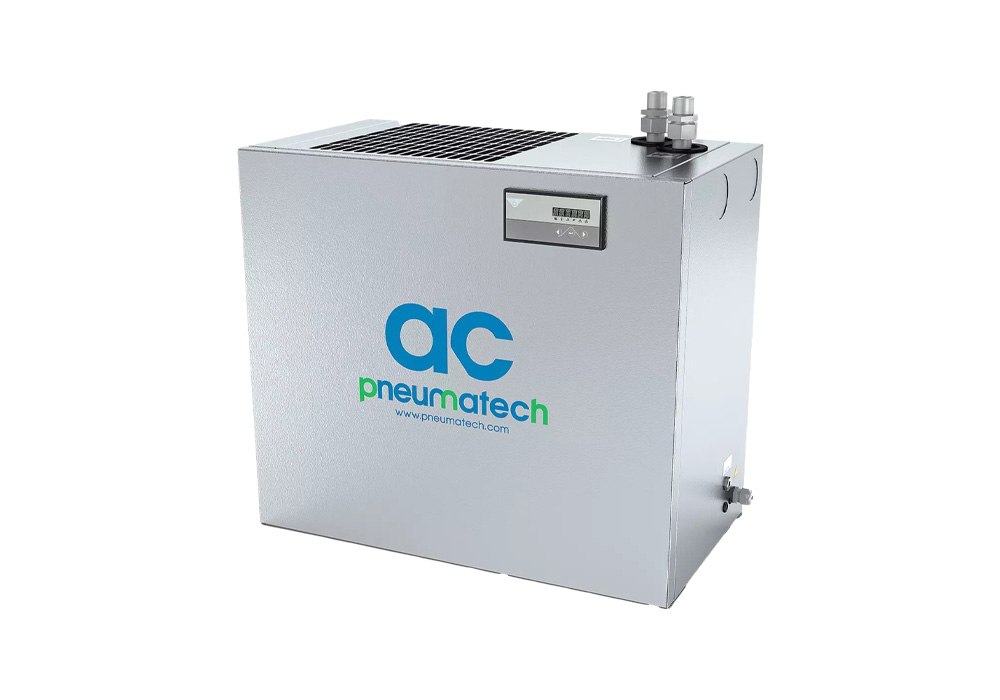
Moisture in compressed air can cause corrosion, pneumatic equipment problems and production-quality issues. The AD 15–4200 range uses refrigeration technology to cool moisture-laden compressed air, condense water vapour and remove the resulting condensate before the air reaches the downstream network.
As a non-cycling design, the refrigeration circuit maintains continuous refrigerant flow, providing straightforward and stable operation for industrial compressed-air systems.
AD 15-425 50Hz | |
|---|---|
Model | Nominal flow rate (m3/h) |
AD 15 | 22 |
AD 20 | 36 |
AD 30 | 50 |
AD 40 | 72 |
AD 65 | 108 |
AD 85 | 140 |
AD 105 | 180 |
AD 125 | 216 |
AD 145 | 245 |
AD 185 | 313 |
AD 230 | 389 |
AD 270 | 461 |
AD 355 | 601 |
AD 425 | 720 |
AD 530-4200 50Hz | |
|---|---|
Model | Nominal flow rate (m3/h) |
AD 530 | 900 |
AD 635 | 1080 |
AD 750 | 1440 |
AD 1000 | 1800 |
AD 1250 | 2100 |
AD 1600 | 2700 |
AD 1800 | 3000 |
AD 2200 | 3744 |
AD 2500 | 4200 |
AD 3000 | 5040 |
AD 3500 | 5940 |
AD 4200 | 7200 |
The refrigeration dryer removes moisture by cooling compressed air below the temperature at which water vapour condenses.
Step 1 – Moist Compressed Air Entry
Warm, moisture-laden compressed air enters the dryer.
Step 2 – Air-to-Air Pre-Cooling
Incoming compressed air exchanges heat with the outgoing dry air.
Step 3 – Refrigeration Cooling
The pre-cooled air passes through the air-to-refrigerant heat exchanger.
Step 4 – Moisture Condensation
As the compressed air temperature falls, water vapour condenses into liquid water.
Step 5 – Condensate Removal
The collected moisture is discharged through the zero-loss electronic drain.
Step 6 – Air Reheating
The dry compressed air is reheated through the air-to-air heat exchanger.
Step 7 – Dry Air Delivery
The treated air returns to approximately room temperature, helping prevent condensation in downstream piping.
Stable Non-Cycling Operation
The refrigeration circuit operates continuously, providing straightforward and dependable drying for compressed-air systems with relatively steady demand.
Reliable Moisture Removal
Cooling compressed air causes water vapour to condense, allowing the moisture to be removed before it reaches downstream equipment.
Up to +4°C Pressure Dew Point
The current specification provides a pressure dew point of up to +4°C / 39°F, suitable for many general industrial applications.
Zero-Loss Condensate Drain
The electronic drain removes accumulated condensate without continuously venting compressed air, helping preserve system efficiency.
Hot-Gas-Bypass Protection
The hot-gas-bypass valve helps prevent ice formation during low-airflow conditions, supporting stable dryer operation.
Real-Time Dew-Point Monitoring
The digital controller provides real-time pressure dew-point information, allowing operators to monitor dryer performance directly.
Wide Capacity Range
With models from 22 to 7,200 m³/h, the range can accommodate applications from smaller workshops to large industrial compressed-air installations.
Environmentally Considered Refrigerant
The referenced range uses R513A refrigerant, selected for lower global-warming impact compared with older refrigerant options.
High-Temperature Air Handling
AD 15–270 models are specified for inlet temperatures up to 55°C, while AD 355–4200 models support up to 60°C.

Dryer Technology
Condensate Management
Controls & Monitoring
Refrigeration System
Electrical Configurations
Oil-Injected, Rotary Screw Compressor